Using a 3 Steps Business Infographic Template for Clear Communication
In the landscape of modern business communication, clarity and speed are paramount. Whether you’re onboarding a new team member, pitching a service to a client, or explaining a core company process, the challenge is always the same: how do you convey information in a way that is immediately understood and easily remembered? This is where a focused visual tool like a 3 Steps Business Infographic Template becomes invaluable. It is not merely a graphic; it’s a structured framework designed to distill a process, concept, or value proposition into three digestible, sequential parts.
Understanding the Template’s Role in Your Workflow
A 3 Steps Business Infographic Template fits into a broader communication and planning process. It often serves as the final, polished output of a deeper analytical stage. Before you even open the design file, you’ve likely brainstormed, researched, or mapped out a more complex workflow. The template’s job is to synthesize that complexity. It forces you to prioritize and identify the three most critical stages, phases, or pillars of your subject. This act of simplification is itself a powerful strategic exercise, ensuring you and your audience focus on the essentials.
Consider its use within a project lifecycle. During the initial planning phase, you might use the template to visually define the project’s key implementation stages for your team. During execution, it can serve as a reference guide posted in a shared workspace, keeping everyone aligned on the core phases. After a project concludes, the same infographic can be repurposed as a case study asset, showcasing your methodical approach to prospective clients. Its utility spans before, during, and after key activities.
Core Features for Practical Customization
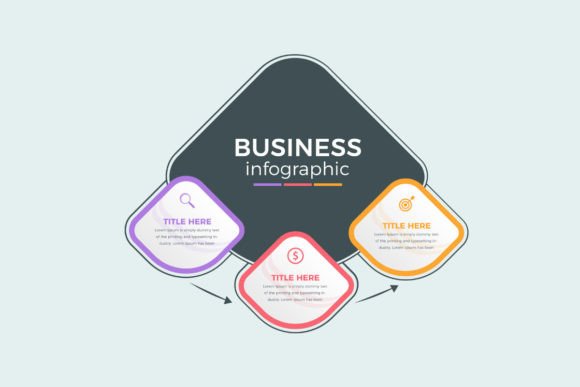
The specific package including an AI file, EPS file, and preview JPEG is designed for maximum practical integration into diverse professional environments. The editable vector files (AI and EPS) mean the graphic isn’t a static image. You can integrate it directly into existing brand workflows. Change colors to match your company’s style guide using Adobe Illustrator or compatible vector software. Modify the text to reflect your specific three steps—whether they are “Research, Develop, Launch” for a product team or “Assess, Strategize, Execute” for a consultancy.
The use of free fonts ensures compatibility and avoids licensing headaches when sharing files across departments or with external freelancers. This thoughtful construction makes the template a true starting asset, not a finished product. It invites you to make it your own, embedding it seamlessly into your existing suite of presentation decks, internal documentation, website content, and marketing materials.
Integration with Other Tools and Resources
A powerful aspect of using this template is how it interacts with other elements of your professional toolkit. It rarely exists alone. For instance, the three steps defined in your infographic can become the agenda headings for a corresponding workshop or meeting series. The visual can be imported into a project management platform like Asana or Trello as a cover image for a project board, visually reinforcing the planned stages.
For content creators and marketers, the infographic can be the cornerstone of a multi-format content rollout. The three steps become the outline for a blog post, the segments of a short video tutorial, or the key points in a social media carousel. This creates consistency across channels, reinforcing the message through repetition in different mediums. Furthermore, by using the editable vector source, a designer can easily extract individual graphical elements—like the numbered icons or background shapes—to use in other related assets, ensuring a cohesive visual language across all project outputs.
Preparation and Implementation Tips for Effective Use
To integrate a 3 Steps Business Infographic Template smoothly, start with content preparation before design. Clearly define your end audience and the single core message you need them to retain. Then, critically analyze your full process to distill it into three logical, progressive steps. Avoid forcing a four-step process into three; the strength of the template is in genuine simplification. Once your steps are clear, the design customization is straightforward. Use the editable text boxes to write concise, action-oriented headings and brief supporting points.
For organization and efficiency, create a dedicated folder for your infographic project. Store the original template files, your customised AI/EPS versions, and exported PNGs or JPEGs for various uses (web, print, presentation). This maintains version control and saves time when you need to revisit or update the graphic for a similar future project. The template’s structure promotes consistency; if you create multiple infographics for different departments using the same base template, your organization develops a recognisable visual style for explaining processes, which aids in internal communication and brand coherence.
Long-Term Use and Quality Control
Thinking beyond a single project, this type of template supports long-term quality control in communication. By establishing a standard format for process explanation, you ensure that all such communications meet a baseline level of clarity and visual professionalism. It becomes a reusable resource in your company’s asset library. When a new team needs to explain their workflow, they don’t start from a blank canvas; they start from an approved, effective template, saving time and upholding a standard.
The vector-based nature of the core files also ensures longevity. Unlike a low-resolution JPEG that becomes unusable for print or scaling, the AI and EPS files can be scaled and adapted for future needs without loss of quality. As your business evolves, you can update the steps, refresh the colors, and repurpose the template indefinitely. This makes it a sustainable tool, not a disposable one. For the productivity-minded user, this is key—investing time in customising a robust template once yields returns across many scenarios and over many months.
Workflow Examples Across Professions
To ground this in practical reality, consider a few specific workflow examples. An entrepreneur might use the template to create a clear, visual explanation of their service delivery process for their website’s “How It Works” page, reducing client uncertainty. An educator could adapt it to outline a three-stage learning module for a course syllabus, providing students with a visual roadmap. A freelancer might incorporate it into a proposal document to visually break down their project approach, demonstrating structured thinking.
In a marketing team, the template could be used to visually plan a campaign rollout: Step 1: Awareness (Social Teasers), Step 2: Engagement (Content Launch), Step 3: Conversion (Offer Promotion). This visual then guides the team’s weekly priorities. For small business owners, it can simplify complex operational procedures, like inventory management or customer onboarding, into easy-to-follow guides for staff. In each case, the template serves as a visual anchor, turning abstract plans into concrete, shared understanding.
Ultimately, a well-employed 3 Steps Business Infographic Template transcends simple decoration. It becomes a functional piece of your operational language. It demands clarity from you as the creator and delivers comprehension to your audience. By focusing on three steps, it embraces the cognitive principle that people best absorb information in chunked, progressive sequences. When integrated thoughtfully into your preparation, tools, and long-term resource management, it stops being just a file you download and becomes a repeatable method for making your ideas understood.