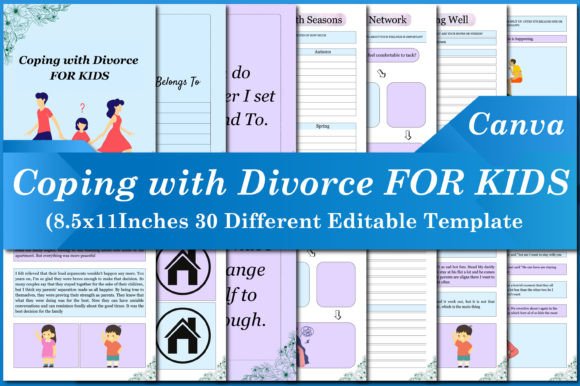
Coping with Divorce for KIDS Canva: A Strategic Tool for Supporting Children
When families navigate the difficult terrain of divorce, the emotional landscape for children can be complex and overwhelming. Adults in their support network—parents, educators, therapists, counselors—often seek practical, structured resources to guide this sensitive process. The Coping with Divorce for KIDS Canva template collection emerges not just as a set of printable pages, but as a strategic instrument for deliberate emotional support and developmental planning.
What Is the Coping with Divorce for KIDS Canva Resource?
This resource is a curated, professional-grade package designed specifically for adults helping children cope with familial change. It comprises over 30 distinct templates, each targeting a specific aspect of the divorce experience. From the Checklist – Coping with Divorce FOR KIDS to interactive pages like Today I Feel - Draw Your Feelings and My Support Network, the collection provides a framework for engagement. The offering includes high-quality, print-ready PDF files optimized for Amazon KDP publishing, an editable Canva link for customization, and a tested 8.5x11 inch format with CMYK color and 300 DPI resolution, ensuring professional output.
Its strategic utility lies in its structure. It transforms abstract concepts of emotional support into actionable, tangible activities. For the adult user—whether a parent creating a personal workbook, a therapist developing session materials, or an educator preparing classroom resources—it offers a pre-designed scaffold. This saves valuable time and mental energy, allowing the focus to shift from creating the medium to curating the message and facilitating the child’s journey.
The Strategic Value of Intentional Emotional Toolkits
Using tools like the Coping with Divorce for KIDS Canva templates thoughtfully goes beyond simple activity provision. It supports core goals in child development, communication, and family dynamics during transition.
Planning and Positioning Support
The sequential and thematic variety of the templates—Changing With Seasons, My Family Changing, Stories From Other Kids—allows an adult to plan a progressive support pathway. You can position different activities to meet specific emotional milestones: initial adjustment, building new routines, processing complex feelings. This planned approach prevents haphazard, reactive support and establishes a consistent, reliable framework the child can depend on.
Enhancing Communication and Creativity
Pages like Draw Your Feelings and Thought Tracker are designed to bypass the limitations of verbal expression for children. They offer alternative channels for communication, unlocking insights that conversation alone might not reveal. For the adult, this enhances understanding and guides more targeted, effective support. The editable Canva link is a critical feature here, allowing you to adapt prompts or imagery to better resonate with a specific child’s context, making the tool a creative partnership.
Operationalizing Coping Skills
The inclusion of templates explicitly titled Divorce Coping Skills and Helpful not Helpful moves from vague advice to operational practice. These pages help children concretely identify and categorize behaviors and thoughts, building metacognition—the ability to think about their own thinking. This is a foundational skill for long-term emotional resilience, turning abstract “coping” into a set of manageable, repeatable actions.
When and How to Approach Using These Templates
The decision to utilize such a resource should be grounded in the specific needs of the child and the capacities of the adult. It is not a universal solution but a flexible toolkit.
Key Considerations Before Implementation
- Assessment of Need: Is the child struggling with expression, routine, or understanding the change? Different templates target different needs.
- Adult Preparedness: The adult must be ready to engage with the content created by the child. It requires time, emotional presence, and follow-up discussion.
- Customization Context: The editable Canva link provides strategic leverage. Consider customizing My Support Network with actual photos or altering Changing Homes to reflect the child’s specific living situation.
A Practical Approach for Intentional Use
- Begin with Exploration: Use open-ended pages like Draw Your Feelings or Today I Feel to establish a baseline of the child’s emotional state.
- Progress to Structured Reflection: Introduce tools like the Checklist or Thought Tracker to help organize feelings and experiences.
- Build Towards Action: Utilize the To Do List and Coping Skills pages to translate reflection into practical, daily steps and healthy habits.
- Foster Connection and Perspective: Pages like My Support Network and Stories From Other Kids (which you can populate with tailored stories) combat isolation and normalize the experience.
The entire process should be paced, voluntary for the child, and integrated into a broader support system. The book’s design, ready for Amazon KDP upload, also allows for the strategic creation of a physical, enduring artifact—a workbook the child can own and revisit, which can be more impactful than transient digital files.
Risks of Use Without Clear Goals or Context
While powerful, deploying the Coping with Divorce for KIDS Canva templates without strategic intent carries risks. Providing these activities as a one-time, disconnected task may feel perfunctory to the child and fail to build trust. If an adult uses them without the willingness to process the child’s responses, it can inadvertently signal that the child’s feelings are merely an assignment to complete. Furthermore, using the templates in a rigid, linear order without adapting to the child’s changing daily emotions may miss critical, immediate needs. The tool is a facilitator of engagement, not a replacement for it.
Grounding Strategy in Realistic Use Cases
Consider a parent who customizes the Changing Homes template with drawings of both homes and uses it over several weeks to discuss positives and concerns about each space. Or a school counselor who uses the editable link to create a slightly altered My Wishing Well for a group session, fostering shared but private expression among peers. A therapist might combine the Helpful not Helpful page with specific behavioral examples from the child’s week, making the coping skills lesson directly applicable. In each case, the template is the starting point, but the strategic, thoughtful application by the informed adult creates the value.
Achieving Long-Term Results Through Structured Support
The ultimate goal of any support resource is to contribute to positive, long-term outcomes. The design of this Coping with Divorce for KIDS Canva collection, with its focus on skill-building (Divorce Coping Skills), self-awareness (Thought Tracker), and system mapping (My Support Network), aligns with that objective. It helps children not just process an immediate event, but develop emotional tools they can use throughout life. For the adult decision-maker—the parent, professional, or publisher—investing in such a structured tool represents a commitment to methodical, quality support. It shifts the approach from improvisation to intentional guidance, potentially yielding more stable, confident, and resilient outcomes for the child navigating family change.
Your presence and support in a child’s life during such a transition mean the world. Resources like this, used with purpose and care, can help channel that support into a clear, comforting, and empowering path forward.